

Information and self-help guide
Vaginismus is when the muscles at the opening of the vagina squeeze shut or tighten automatically whenever you try to insert something. It can be painful and upsetting, but it can be treated.
Vaginismus is more common in women in their late teens to early 30s. However, anyone with a vagina can experience it.
Contents
About vaginismus
Self-help: treatments you can do yourself
- Vulval skin care
- Self-exploration
- Relaxation techniques, mindfulness and meditation
- Diaphragmatic breathing
- Pelvic floor muscle exercises
- Superficial pelvic floor massage
- Internal vaginal massage
- Use of vaginal trainers
Moving onto penetrative sex
Symptoms of vaginismus
The main symptom is your vaginal muscles tightening up on their own when you try to put something into your vagina. This can also trigger a burning or stinging pain at the entrance.
It can happen when:
- You put a tampon into your vagina.
- You try to have vaginal penetration during sex, including with a finger, sex toy or penis.
- You have cervical screening (a smear test).
- Something is put near your vagina because of fear of penetration.
Vaginismus does not necessarily affect your ability to get aroused and enjoy other types of sexual contact. However, some people experience lower libido or avoidance behaviours when penetrative sexual intercourse becomes painful.
What causes vaginismus?
While there are many potential causes of vaginismus, for many people there is no clear cause. Some people can develop vaginismus even if they have previously enjoyed painless penetrative sex.
Possible causes include:
- Pain or discomfort during a first attempt at sex or tampon use, which can start a cycle of anxiety and muscle tension.
- Skin irritation causing pain or discomfort that leads to muscle tightening.
- Infections such as thrush.
- Skin conditions such as eczema.
- Washing with products, including intimate washes, which can irritate sensitive skin.
- An unpleasant medical examination.
- A difficult experience giving birth.
- Menopause-related changes causing the vulval and vaginal skin to feel delicate and less stretchy.
- Fears or worries about sex.
- Cultural, family or social messages that create fear around sex.
- Fear of sexually transmitted infections or pregnancy.
- A difficult first sexual experience.
- Sexual assault, rape or other unwanted sexual experiences.
- No obvious identifiable cause.
If penetration has been painful before, the vaginal muscles may instinctively tighten in anticipation of it happening again. This can continue to make penetration painful or impossible, even if the original cause is gone.
Different treatments for vaginismus
There are different treatments for vaginismus. Many of these can be done by yourself. These are referred to as Self-help treatments.
| Psychosexual therapy | A type of talking therapy that aims to help you understand and change your feelings about your body and sex. | If you are interested in this, please discuss with your healthcare professional. |
| Relaxation techniques | Mindfulness, breathing and gentle touching exercises to help you learn to relax the vaginal muscles. | Self-help |
| Pelvic floor exercises | Squeezing and releasing exercises to gain control of the vaginal muscles and lengthen the pelvic floor muscles using diaphragmatic breathing. | Self-help |
| Sensate Focus | Exercises to help with relaxation during sex and increase libido. | Self-help |
| Vaginal trainers | Tampon-shaped objects of increasing sizes which help you gradually become accustomed to vaginal insertion. | Self-help |
Treatment is usually introduced by specialised therapists. You are then generally expected to practise exercises at home. If you are in a relationship, you can choose to involve your partner.
Treatment principles
When penetration has been painful or difficult, the body can become more protective of the vaginal area. This may lead to increased sensitivity, anxiety about penetration and automatic tightening of the pelvic floor muscles, known as hypersensitivity.
The aim of many of the self-help exercises in this leaflet is to help the body and mind feel safe again through desensitisation and familiarisation.
Hypersensitivity, desensitisation and familiarisation explained
Hypersensitivity: When the skin, nerves or muscles react too strongly to touch, causing sensations that feel very intense, uncomfortable or painful. At the entrance of the vagina, this may be described as provoked vestibulodynia.
Desensitisation: A process of gentle, repeated touch that helps the body become more comfortable with sensations over time. As the area becomes more familiar, the nerves respond less strongly and sensitivity may reduce.
Familiarisation: Giving the body and mind time to become comfortable with touch and movement in this area. Regular, gradual practice helps reduce fear, anxiety and surprise responses, allowing confidence to build over time.
Self-help: treatments you can do yourself
First step: Stop if penetration is painful
If vaginal penetration is painful, it’s important to firstly stop trying to continue with penetrative sex.
Repeating painful experiences can reinforce pain, distress, anxiety and muscle tightening.
Vulval skin care
Taking care of the skin around your vulva can help your vaginismus treatment:
- It’s important to avoid using soaps and perfumed products. Instead, use a soap substitute or emollient (e.g. Oilatum or Hydromol) to wash your vulva.
- If the skin is sore or irritated, consider using a moisturiser once or twice daily.
- Examples include aqueous cream, emulsifying ointment or similar products.
- Natural products such as coconut oil or intimate balms may also help.
- Applying an emollient may improve skin comfort and assist exploration of the area.
Self-exploration
Getting to know the vulva and vagina can help make this area feel more familiar.
- Explore the area as part of your normal washing routine.
- Regular touch can help reduce hypersensitivity.
- Apply an emollient and begin touching the outer labia before gradually moving towards the vaginal entrance.
- Over time the body becomes more comfortable with touch without triggering pain.
- If you feel able, try inserting a finger into the vagina.
- Some people initially find using a small vaginal trainer easier than using a finger.
Relaxation techniques, mindfulness and meditation
Finding ways to help the mind and body stop focusing on pain or the expectation of pain may help reduce anxiety around penetration.
Mindfulness helps you stay present and focus on sensations and arousal without worrying about penetration.
Helpful resources
- Michelle Kenway pelvic floor release exercises: www.pelvicexercises.com.au
- Sniff, Flop and Drop Technique: www.pelvicphysiotherapy.com/release-exercises
- POGP relaxation resources: www.thepogp.org.uk
- Shelly Prosko relaxation resources: physioyoga.ca/the-6-stages-of-toilet-meditation
Diaphragmatic breathing
A breathing technique shown to help release pelvic floor muscle tension.
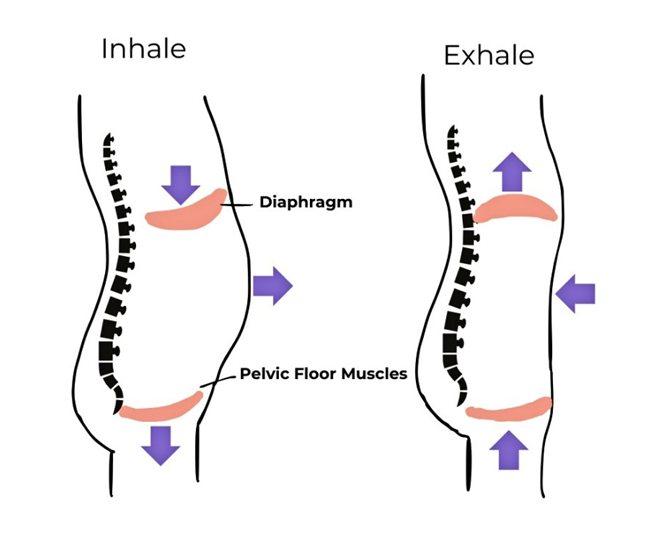
| Inhale | Exhale |
|---|---|
| Tummy softens and expands | Tummy returns towards the body |
| Sitting bones widen | Sitting bones move back together |
| Tailbone lengthens away from the pubic bone | Tailbone returns to its resting position |
| Pelvic floor muscles lengthen and descend | Pelvic floor muscles return to resting position |
For a fuller guide visit: nhslothian.scot/guide-to-good-breathing-pelvic-floor-physiotherapy
Pelvic floor muscle exercises
These exercises help develop awareness and control of the pelvic floor muscles.
How to identify your pelvic floor muscles:
Imagine you are stopping passing of urine or wind
Can you squeeze these openings?
Imagine a small pearl sits at the entrance of your vagina
Can your grip it and lift it inside? Try to do this as you breathe out, hold it in for a few seconds, continue to breath, then lower it down and release the pearl again.
Contract to relax: lift the muscles and then let go
- Can you feel the muscles squeeze and lift inside?
- Can you feel the same amount of release or let go?
- Try 5-10 repetitions 3 times per day.
Pelvic Floor Release / Drop (also known as a Reverse Kegel)
This is the lengthening and stretching of the pelvic floor.
When done correctly with a diaphragmatic breath (see above) you should feel a “drop” of the muscle particularly around the anus.
Another effective method for relaxation of the muscles includes visualising increasing the distance between your pubic bone and tailbone, think about spreading the space between your sitting bones.
Use a Mirror
- Using a handheld mirror, part your legs look at the space between your vulva (lips).
- Watch the contraction and relaxation of the pelvic floor muscles in your vagina as you consciously tell them to tighten and then relax.
- During a Pelvic Floor Release (described above), you should see the anus release and your perineal body move downwards towards the mirror.
Superficial pelvic floor massage
- Get yourself into a comfortable position. You could use a mirror to assist you with the massage.
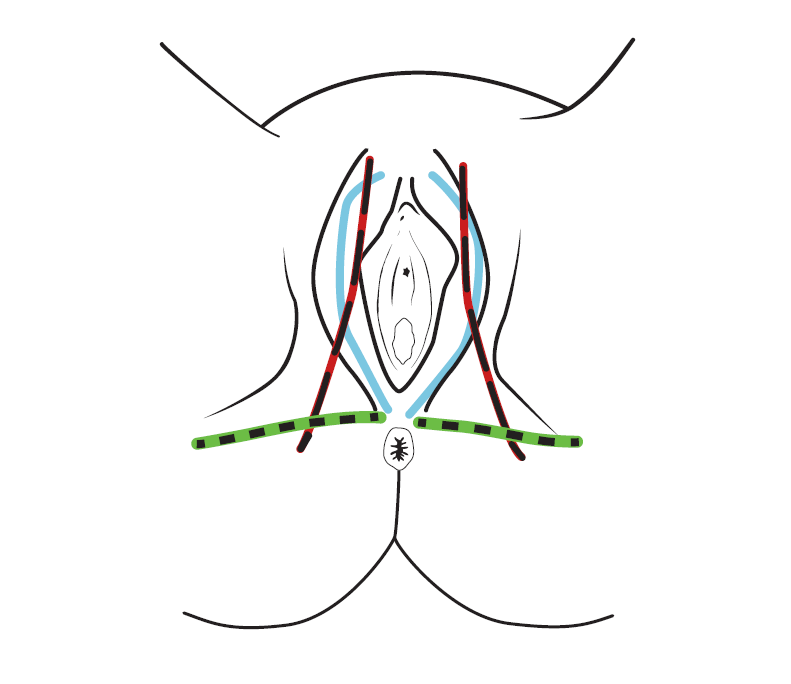
- Using your index and middle fingers apply gentle pressure along the 3 directions shown in the diagram above, demonstrated in red dash line, light blue line and green dotted line (your physiotherapist can demonstrate these with you).
- As you feel more comfortable and less pain you can gradually increase the pressure applied to the external vaginal muscles.
- Aim to complete this for 3-4 minutes at least 3 times a week. Similarly, to the above exercises this will be most effective if completed every day.
Internal vaginal massage
Once external massage feels comfortable, the next step would be internal massage.
- Insert one finger, or use a small vaginal trainer, into your vagina. Start using a sweeping motion with downward pressure to move in a rhythmic movement from 3 to 9 o’clock via 6 o’clock (where 12 o’clock is the clitoris and 6 o’clock is the perineum).
- Then, you can apply gentle pressure to the right and left side to stretch your pelvic floor muscles.
- Begin with a gentle contraction of your pelvic floor muscles, hold for 3-5 seconds and relax.
- Then press against your muscles using the pad of your finger/thumb. Hold for 10-30 seconds as able. Your physiotherapist can demonstrate this to you.
Using vaginal trainers
Gently exploring the entrance to the vagina with the little finger or the smallest vaginal trainer allows a gradual retraining of the vaginal muscles to accept something being inserted.
This may seem difficult at first and can be a slow, steady process. Repeat again until it gradually gets easier and then try increasing the size of the trainer or using larger fingers.
Over time, your vaginal muscles and the sensations in this area will not produce a protective spasm and will eventually lead to you being able to have vaginal sex.
Important tips for using trainers
- You are trying to be low threat, aiming for familiarisation and to desensitise the nerves in this area, so it is best if you can use them daily for a few minutes. It needs to feel like “no big deal” and part of your daily self-care routine.
- You may try them in the bathroom, perhaps in the shower, or you could find it easier in the bedroom or another warm and comfortable place. Somewhere you can feel relaxed and safe.
- Position is important:
» In most people, the vagina goes up and backwards towards the lower back. If lying flat makes it harder to find the right position, try tilting your pelvis upwards using a rolled-up towel or small pillow under your buttocks.
» Alternatively, you can stand up with one leg on a stool or the side of the bath, tip your pelvis forward to bring your vagina in line with the entrance.
- Once you have found a comfortable position, place the trainer at the vaginal entrance. Then tighten your vaginal muscles, let them relax and then gently advance the trainer through the relaxed muscles as you take a deep breath in, lengthening the muscles as practised in the diaphragmatic breathing technique.
- You only need to go slightly inside the vagina, hold the trainer for a few seconds and continue to complete 3-4 deep breaths. You can then move the trainer
- On the next inhale bring the trainer out. It is helpful to repeat this 2-3 times. The second time is often easier because your body is prepared, less tense and knows what to expect.
- When you are confident and comfortable with one size of trainer, you can move up to the next size. However, it is better to start the session with the smaller trainer first then work up.
Moving on to penetrative sex
First steps:
- It is helpful to agree with your partner that you will avoid any penetration with their penis or similar sized sex toy while trying to build up confidence and familiarity with your vagina using trainers.
- Intimacy can be very important to a relationship so continue to touch and be curious of gentle touch, to other erogenous zones. Focusing on non-penetrative sexual pleasure can help you keep connected while reducing your anxiety. Try to develop intimate options which are pleasurable, rather than just a prelude to intercourse.
Sensate focus – Sensate focus is a type of intimate touching with the focus on the pleasure felt from both touching and being touched. The aim is exploration for pleasure and with no focus on genital touching. These exercises can help with this if intimacy has become difficult. NHS Highland Sexual Health have provided information on Sensate focus here: highlandsexualhealth.co.uk/sensate-focus
When you feel ready:
- The next step is to try to include use of trainers with your partner. This is so that your body can learn to relax in the presence of another person. Then you can show them how to insert it with you controlling the direction and movement helping them learn what works for your body.
- Another step is to let your partner gently put a finger in your vagina. The point is to get your partner involved while still feeling safe enough to hand over a little bit of control. Communication and setting a pace at which you are comfortable is key.
- If you can manage the size 2 trainer (and certainly the size 3), then you could be able to manage intercourse. However, it can be harder to relax your muscles with your partner in a sexual context. So, it is best to take things in small steps. It is important to agree that your partner must wait or stop altogether if you ask them to. This will help you feel in control and safe.
- When you are ready you can try ‘containment’ of the penis or similar-sized sex toy in the vagina. ‘Containment’ means you are going to insert the penis or similar-sized sex toy as if it were a trainer. It is important you feel safe and in control here.
- Explain to your partner that they must wait or stop if you ask them to. Before trying to use your partner’s penis or a similar-sized sex toy for the first time it can be helpful to use the trainers immediately beforehand. It is important to agree that your partner must wait or stop altogether if you ask them to to prepare you to be relaxed and ready.
- Using the penis or similar-sized sex toy like you used the trainers; allow gentle entry into the vagina, just a few inches inside. Just stay still like this for a few moments then gently allow it to slip out again. Try this in various positions with both yourself and then your partner being in control of the insertion.
- You can go on to introduce movement when you feel ready. Do this very gradually, while using the positions which you find most comfortable. You should be prepared to find that sometimes things will progress smoothly and at other times you will find it difficult.
Remember: Other aspects of your life can affect your progress, and your ability to relax and focus on these exercises. If this happens, be kind to yourself and restart at an earlier stage to improve your confidence before moving on. In the meantime, try to keep up the fun and pleasure of intimacy with your partner.
Further professional help
While some people can help themselves to overcome vaginismus and sexual pain, sometimes professional help is needed.
If the steps described in this guide don’t seem to work, or seem too difficult or frightening to try, please talk to your GP or practice nurse. There may be a simple reason for your pain. If referral is needed, they can send you to the person best able to help you.
They may refer you to Sandyford’s Sexual Problems Service. Our staff are a multidisciplinary group including physiotherapists and counsellors with specific sexual problems training.
Our medical staff are trained by the Institute of Psychosexual Medicine or other professional organisations.
We help with a variety of issues. For more information visit the Sexual Problems Service page: